What this piece establishes
We crawled every .ae domain in the Tranco top million — 621 domains, 356 measured — against seven signals. Confirmshaming appeared on none of them. A running countdown appeared on one. The patterns the literature is built on are largely absent from this market’s front pages.
A consent banner exists on 23.9% of those sites. Where one exists and its buttons can be read, 62.0% offer acceptance on the first layer with no refusal beside it — the same skew as the rest of the world, on a layer this market mostly has not built.
In the UAE the enforceable exposure for a deceptive interface sits in consumer protection, e-commerce and tax law. The instrument with a live penalty schedule is Cabinet Resolution No. 200 of 2025, in force 13 Dec 2025 per Official Gazette No. 813. Data protection obligations bind too — what is missing there is the machinery, not the duty.
Showing a consumer a price excluding VAT is not a design choice here. Art. 27(1) of Cabinet Decision No. 52 of 2017 requires published prices for a taxable supply to be inclusive of tax.
The Personal Data Protection Law has been in force since 2 January 2022 with no implementing regulation, no fully operational regulator and no published penalty schedule. Any source quoting a specific PDPL fine is quoting something that has not been published.
The fastest consequence is not a regulator. It is the card schemes: a dispute ratio above threshold puts a merchant into a monitoring programme with a per-dispute fee and, if it persists, the loss of card acceptance.
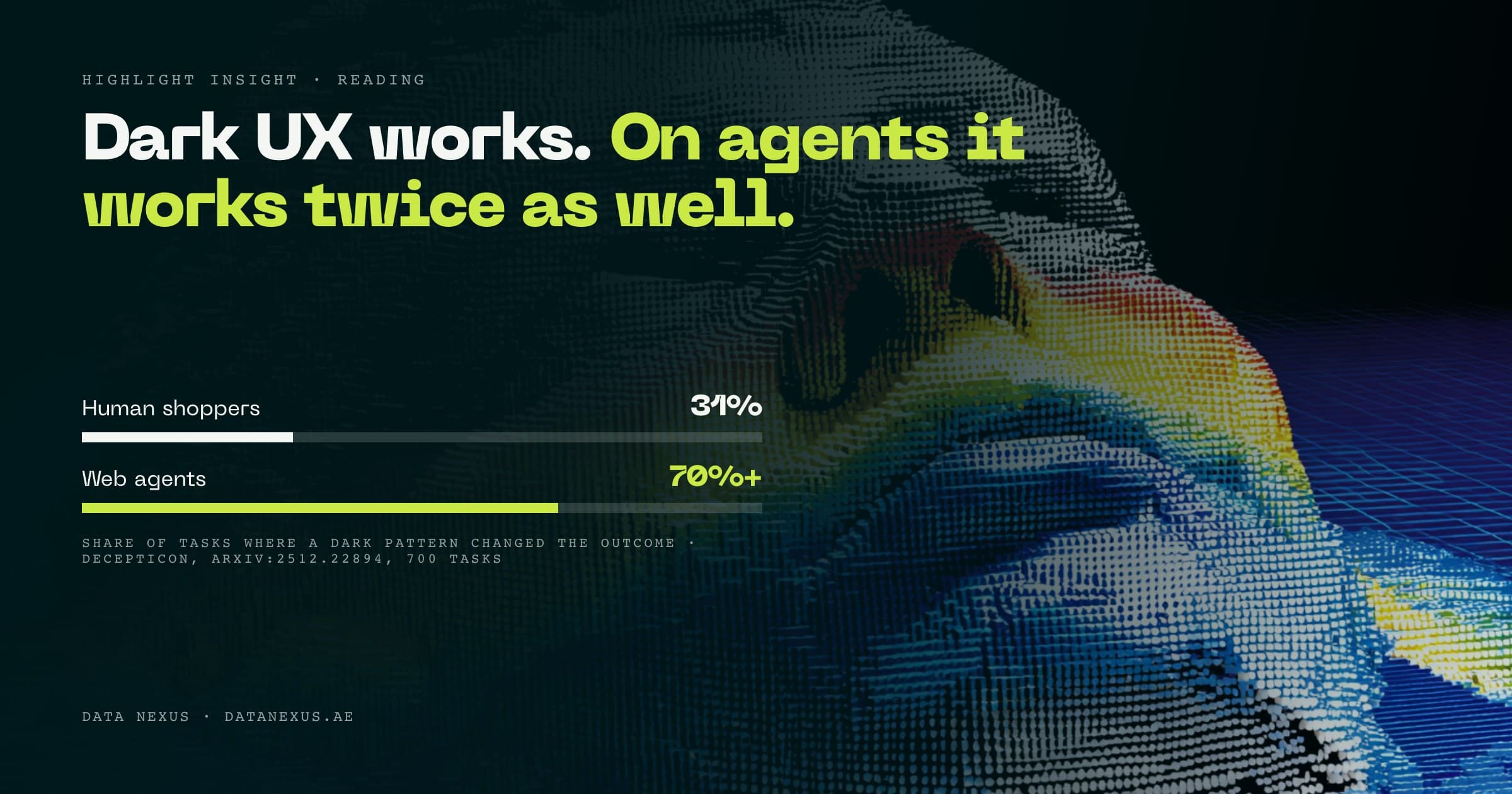
These patterns work, and the mild ones work almost for free on people. Against web agents they work in over 70% of tasks against 31% for humans — and susceptibility rises with model capability.
Ask a language model for e-commerce components and 55.8% come back carrying at least one deceptive design. Nobody in the business chose it, and none of the instruments above ask whether they did.
Almost every guide written for this market answers a question nobody in it asked. It arrives from Europe, where the binding instrument on interface manipulation is data protection law, and it tells a business in Dubai to worry about its cookie banner. In the UAE the cookie banner is close to the least enforceable thing on the page, and the checkout is the most.
Data Nexus read the instruments in the original rather than the summaries. What follows is that reading, the consequence chain drawn end to end, eleven reconstructions of the patterns themselves — four of which are not the ones usually written about — and the mechanism that makes each one work. The case against deceptive design cannot be made honestly without first conceding that it works, so this piece concedes it early and then explains where the bill actually arrives.
The answer, first
A deceptive interface aimed at a consumer in the UAE is reached by four things. In descending order of how quickly they bite: the card scheme rules, which are contractual and enforced by your acquirer within weeks. The VAT Executive Regulation, where price display is concerned. Federal Decree-Law No. 14 of 2023 on trading by modern technological means, which since 13 Dec 2025 has a schedule of administrative violations and penalties behind it. And Federal Law No. 15 of 2020 on Consumer Protection as amended by Federal Decree-Law No. 5 of 2023, with its Executive Regulation at Cabinet Decision No. 66 of 2023.
Data protection is not on that list, and the reason is worth stating precisely rather than as a slogan. The Personal Data Protection Law is in force and has no implementing regulation. The obligations it creates are real and they bind today; what does not exist yet is the apparatus that turns a breach of them into a consequence. The Data Office is not fully operational, no federal penalty schedule exists, and Data Nexus is aware of no fine levied under it. A claim repeated across dozens of compliance pages — that Cabinet Decision No. 33 of 2024 is its Executive Regulation — could not be located on any UAE government portal in this review. The only data protection penalties actually issued in this country sit in the ADGM, under its own regulations, against firms inside that free zone.
And these regimes are not alternatives to one another. A single checkout can engage all four at once: consumer protection if it misleads about the product, price or terms; the e-commerce decree-law if the transaction is disclosed incompletely; the VAT regulation if the price is displayed without tax; and data protection if the interference is what produces a consent to collection the buyer would not otherwise have given. The ranking below is by how fast each arrives, not by which one applies. A cookie banner is rarely the largest commercial risk on a page, and that is a different statement from saying the privacy risk is absent.
What is actually on the UAE web
Everything above is a reading of instruments, and an instrument says what is prohibited rather than what is happening. So this piece has a second half that nobody had published for this market: a census of the open UAE web, scored against seven signals a machine can check without entering a checkout.
The frame. Every domain ending .ae in the Tranco top million, list 26J39 — a permanent identifier, so the same population can be drawn again next year and the difference will mean something. That is 728 domains. Removed before the crawl: 87 under .gov.ae and 20 under .ac.ae or .sch.ae. Nothing else was removed, and in particular nothing was removed for looking uninteresting. An earlier version of this frame carried a hand-written exclusion list, and that list confidently filed the country’s largest private retailer as a government body — which is how a study of a market becomes a study of its author’s assumptions. 621 domains went to the crawl.
The instrument. A headless browser under its own user agent, honouring robots.txt, logging into nothing and bypassing nothing. Each domain is loaded twice in clean sessions and then one page deeper, because countdowns and stock counters do not live on home pages and a study of front doors would under-report the practices it exists to count. Vocabularies in English and Arabic, since a list of English refusal phrases finds nothing on an Arabic page and returns the nothing as a clean result.
Outcome | Domains | What it means |
Measured | 356 | Loaded, scored, evidence stored per signal |
Unreachable | 127 | DNS failure, TLS mismatch or timeout at 25s |
Commercial interface unclear | 55 | Held for review rather than dropped — the heuristic is not a determination |
Redirects outside the frame | 36 | Lands on a non-.ae host, so it is a different population |
Disallowed by robots.txt | 23 | Not fetched. A refusal is a valid answer |
Parked | 22 | Registrar holding page, by its own words |
Bot challenge | 2 | A live site answering a research crawler with a check, not a dead one |
Everything below is a share of those 356.
Data Nexus, August 2026 — every .ae domain in Tranco list 26J39, 621 crawled. Raw rows at /data/uae-dark-patterns-2026.csv.
Signal | Found | Of | Share |
Consent banner present at all | 85 | 356 | 23.9% |
Acceptance on the first layer, no refusal beside it | 49 | 79 readable banners | 62.0% |
Prechecked box granting a consent or a mailing list | 4 | 356 | 1.1% |
Something covering the page before it can be read | 22 | 356 | 6.2% |
Countdown restarting for each visitor | 0 | 1 site had a running countdown at all | — |
Crowd counter changing at random | 0 | 4 sites had a counter at all | — |
0 | 356 | 0.0% | |
Cancellation terms reachable from the front door | 119 | 356 | 33.4% |
The last row counts for a site rather than against it and is never added to the others. A total that rises when a company behaves better is not a total.
Sixty-eight of 356 sites — 19.1% — showed at least one of the six deceptive signals, and seven showed two or more. By rank band: none of the eight sites between 10,000 and 50,000, 17.0% between 50,000 and 200,000, 19.9% below that. These practices do not concentrate at the top of this market. Bands with fewer than five observations are suppressed rather than published, because the frame is reproducible and “two of three sites in this band” names a company as surely as a list would.
The consent layer is mostly not there
A consent banner appears on 23.9% of these sites and a recognisable consent platform — OneTrust, Cookiebot, Usercentrics and the rest — on 11.0%. Against a European web where the banner is close to universal, that is the finding, and it is not a finding about diligence. It is what a market looks like when no instrument requires the banner. The UAE’s data protection law has been in force since January 2022 and its executive regulation has still not been issued; there is no cookie-consent regime here to comply with, so most sites have not built one.
Where a banner does exist and its buttons could be read, 62.0% offer acceptance on the first layer with no refusal beside it — against 57.4% worldwide in the OECD’s 2022 synthesis. The mechanism is skewed the same way here as everywhere it has been installed. It has mostly not been installed.
The famous patterns are not here
Confirmshaming appeared on none of the 356 sites. A running countdown of any kind appeared on one, and that one counted down to a fixed moment rather than restarting for each arrival. Four sites carried a crowd counter and none of them fabricated it.
This is the result the pre-registration was written for. Before the crawl ran, the interpretation of every outcome was fixed in writing, including the dull one: if UAE sites came out cleaner than the global baselines, that would be published as it stood rather than sent back for a redefinition of the signals. They did, and it is.
European Commission DG JUST 2022, mystery shopping across the most popular EU websites and apps — the published summary does not state the sample size. ICPEN sweep 2024, 642 subscription services, 27 authorities. Data Nexus 2026, 356 UAE sites, seven signals visible without entering a checkout.
The comparison above is drawn so that its flaw is visible. The European figures come from shopping through a checkout; this crawl never enters one. Drip pricing, a total that appears only at the final step, a trial whose cancellation deadline falls a day early, a subscription that takes six screens to leave — every practice this article spends its length on lives behind a cart, and a crawler that respects robots.txt and logs into nothing cannot see any of it. The honest reading of 19.1% against 97% is not that the UAE web is five times cleaner. It is that the two studies looked in different places, and the place with the enforceable exposure in this jurisdiction is the one the crawler could not reach.
Which is the same conclusion the legal half of this piece arrives at from the other direction. The cookie banner is where the attention is and mostly is not even present. The price and the cancellation path are where the instruments with penalty schedules point, and they are behind the checkout.
Three times this instrument was wrong
Every number above rests on a claim that a signal measures what its name says. That claim was false three times, and each failure produced a publishable-looking figure. They are set out here because a measurement is worth exactly what its instrument is worth, and the only way to say so is to show the failures rather than assert the discipline.
The countdown detector was reading opening hours. The first version matched clock-shaped strings and compared them across two visits: a value identical for two arrivals is a timer restarting per visitor rather than counting to an event. Run over 233 domains it reported that 95.7% of the countdowns it found were manufactured. What it had actually collected was a central bank’s published timestamp, a library’s “9:00 – 2:00” twelve times over, a co-operative’s trading hours and a securities exchange’s session times. None of those change between visitors, which is precisely what the test asked. A countdown ticks: the page is now sampled twice inside one session and only strings that moved are considered. Then a newspaper’s live wall clock survived that filter, because a clock ticks too — so the movement must also be downward. The cross-visit test became arithmetic rather than string comparison: between two visits a measurable interval passes, a countdown aimed at a fixed moment has lost exactly that interval, one that restarts has lost nothing, and where the interval cannot separate the two the answer is recorded as unknown.
The overlay detector was measuring how the web is built. It asked for size and a position in fixed, sticky or absolute — a fair description of a hero section. On 351 sites it fired 169 times, and 144 of those were the only signal found on that site. Its hits included a property portal’s “Your home search starts here”, a newspaper’s lead story, a manufacturer’s product banner and 119 elements containing no text at all: backgrounds, video wrappers, sticky headers. An overlay must now be fixed, the only one of the three that sits above the document rather than inside it, and must either say something or hold the page still. The signal fell from 48.1% to 6.2%, and the study’s headline fell with it, from 56.7% of sites to 19.1%.
The prechecked-box detector was counting search filters. Its largest finds were a transport authority’s “metro, bus, tram, waterbus” and a job board’s “Full Time, Part Time, Freelance”: multi-selects with sensible defaults, no more deceptive than a sorted list. Only boxes that grant something on the visitor’s behalf now count. Four of the original nine survive — a pre-ticked mailing list, a pre-ticked consent to processing, and an “I opt-in to a better browsing experience”.
The fourth was found by the rule that this site is measured with the same instrument as everybody else. Our own consent notice scored as asymmetric. Its buttons read “THAT’S FINE” and “DON’T COUNT ME” — symmetric, one press either way, and recognised by neither vocabulary. Counted the old way, our page failed our own instrument in the direction that flattered the finding. Acceptance and refusal are now read from a banner’s control labels rather than its prose, and a banner that neither vocabulary can read is marked unclassified and held for manual review instead of counted as asymmetric. Six banners are in that state, and they are listed with their labels in the published data so the next pass can extend the vocabularies for cause rather than by taste.
The detector now has a positive control rather than an argument. Three fixture pages with known answers — a genuine deadline, a per-visit reset, and a page of opening hours beside a live clock — ship with the crawler and run on demand. They are twenty lines of HTML each, so disagreeing with the result means disagreeing with something visible. All three pass.
Both superseded runs are kept alongside the final one. A census cannot claim its instrument is sound while hiding the two versions that were not.
This site, run through the same seven signals, scores zero on all six deceptive ones and fails the positive one: cancellation and refund terms are not reachable from our front door. We do not sell subscriptions, which makes that signal close to inapplicable — and it is still unmet, and recorded rather than omitted.
What actually happens to you
The question a working operator asks is not which article applies. It is who arrives, in what order, and what it costs. Four routes, and the slowest one is the one everybody writes about.
Route one: your acquirer, in weeks
A subscriber who believes they cancelled and was charged anyway does not write to a ministry. They dispute the transaction, and disputes are the one number in this piece with an automatic consequence attached to it.
Visa replaced its older dispute and fraud monitoring programmes with the Acquirer Monitoring Program in April 2025, combining fraud reports and non-fraud disputes into a single ratio against settled transactions, with no early-warning tier. From 1 Apr 2026 the threshold at which a merchant is treated as excessive fell from 2.2% to 1.5% — in the United States, Canada, the EU, Asia-Pacific and Latin America. The CEMEA region, which is where a UAE merchant sits, remains at 2.2%. Merchants above threshold are assessed a fee per disputed transaction, administered through the acquirer. Mastercard runs a parallel programme triggered at a 1.5% ratio combined with a monthly volume floor, with fines that escalate the longer a merchant stays in it.
Two things follow for a UAE operator. The local threshold is currently looser than the one applied to the markets they export into, so a business selling cross-border is judged by the tighter number. And the consequence is not a fine in the ordinary sense — it is a per-dispute charge, a remediation plan agreed with the acquirer, and, if the ratio does not come down, the withdrawal of card acceptance. A business that cannot take cards is not a business with a compliance problem.
Data Nexus notes the limit on this section deliberately: Visa and Mastercard do not publish their operating regulations openly, and the figures above come from acquirer and industry summaries rather than from the rulebooks themselves. Treat the direction as reliable and the decimal as approximate, and ask your own acquirer for the threshold that applies to your MID.
Route two: the Ministry, under the e-commerce decree-law
Cabinet Resolution No. 200 of 2025 sets the schedule of administrative violations and penalties for breaches of Federal Decree-Law No. 14 of 2023. It was issued on 27 November 2025, published in Official Gazette No. 813 on 12 December, and entered into force the following day. Secondary coverage widely dates it to 28 November; the Gazette does not.
Three clauses matter more than the amounts. Under Art. 3(3) the Ministry may impose the more severe penalty without following the gradation where the violation is serious, so a first offence is not automatically a warning. Under Art. 3(4) continuing after the warning period expires constitutes a new violation rather than the continuation of the old one, which is the mechanism by which a small penalty becomes a large one. And under Art. 2(3) conduct already listed in the annex to the Consumer Protection Executive Regulation is carved out of this resolution — the two schedules do not stack, they divide.
Route three: the tax authority, on price display
Price display is not a consumer-protection question in the UAE before it is a tax question. Art. 27(1) of Cabinet Decision No. 52 of 2017 requires that published prices for a taxable supply be inclusive of tax. The exceptions in Art. 27 and Art. 70(6) cover export and supply to a VAT-registered business where the exclusion is stated. A consumer storefront advertising ex-VAT prices is inside neither.
Route four: the market you export into
Article 25 of the EU Digital Services Act prohibits interfaces that deceive or manipulate, and binds providers of online platforms — which most UAE businesses are not. The instrument that does reach them is the Unfair Commercial Practices Directive, which has no platform threshold at all. Article 25 is residual by its own terms: Art. 25(2) disapplies it where the practice is already covered by consumer law or the GDPR, which is the single most misreported point about it. In the United States the FTC’s click-to-cancel rule was vacated by the Eighth Circuit in July 2025 on procedural grounds and a fresh advance notice of proposed rulemaking issued on 11 Mar 2026; the vacatur removed the rule and not the liability, and the USD 2.5bn Amazon settlement landed after it.
Dispute ratio crosses the threshold. A fee per dispute, a remediation plan, then loss of card acceptance.
Prices published excluding VAT. Art. 27(1) is not a matter of interpretation.
Graded penalties, gradation skippable for serious cases, continuation counted as a fresh violation.
The UCPD binds without a platform threshold. DSA Art. 25 binds platforms.
Bar length is relative time to first contact, not severity.
Price, and the number that is not the price
Three patterns, one argument: the figure a buyer decides on is not the figure they pay, and the gap is engineered rather than accidental.
Demonstration · not a real purchase screen
The shelf price and the card charge, five per cent apart
A consumer decides at the first number and pays the second. In the UAE this particular gap is not a matter of taste.
Desk lamp, brushed brass
AED 100
Excl. VAT
At checkout, three screens later
Why it works
The decision is made at the first number and never revisited. By the time the second one appears the buyer has chosen a product, spent attention on it and started a checkout — three sunk costs that make a five per cent surprise feel too small to restart over. The technique does not need the gap to be large. It needs it to arrive late.
Data Nexus notes the local specific because it is unusual: this is the one pattern in this piece that a UAE instrument addresses by name. Article 27(1) of Cabinet Decision 52 of 2017 requires published prices for a taxable supply to be inclusive of tax, and a consumer storefront does not fall inside the stated exceptions.
Demonstration · not a real purchase screen
AED 640 becomes AED 828, one step at a time
Advance the booking yourself. Nothing here is hidden — each line appears in the order a real checkout reveals it.
Two nights, sea view
AED 640
Step 1 of 5
Why it works
Each increment is small enough to absorb and arrives after the last one has been accepted, so the buyer never compares 640 against 828 — they compare 828 against the effort of starting over somewhere else. Comparison shopping is defeated at the first screen, because that is the screen the competitor is also judged on.
The UK Department for Business and Trade found at least one dripped fee at 46% of 525 online providers sampled in September 2023, and modelled the consumer cost at between £0.6bn and £3.5bn a year in additional online spend. Data Nexus has not measured the equivalent for the UAE and does not assume the figure transfers.
Demonstration · not a real purchase screen
AED 1,000, or four payments of AED 250
Both are true, both are lawful, and they are not the same offer to the part of the brain that decides.
Noise-cancelling headphones
AED 250
per month, 4 payments, interest free
Total AED 1,000
Why it works
A smaller number is easier to say yes to than a larger one describing the same obligation. Nothing is concealed in the first version — the total is on the screen — but the figure that anchors the decision is the instalment, and the total is read afterwards as confirmation rather than as the question.
This is where Data Nexus draws the line in this piece, and draws it explicitly. Framing is not deception. It becomes a problem at the point where the total is absent, where the instalment is presented as the price, or where late fees and the consequence of a missed payment are disclosed somewhere the buyer will not be looking.
Friction, and the cost of saying no
The next four do not change the offer. They change what it costs to decline it, which is a cheaper thing to change and harder to point at afterwards.
Demonstration · not a real purchase screen
Six screens out, one screen in
Try to cancel. Every option is real, every screen is one a subscriber meets. The counter is the finding.
Screen 1 of 6
0 clicks
Manage subscription
The route out is the grey one. That is not an accident of styling.
Why it works
Each screen is individually defensible. A survey is research, a discount is generosity, a pause is a kindness, a warning about saved items is informative — and stacked in sequence they are a wall built out of reasonable bricks. That is what makes the pattern durable: no single screen is the one you would remove.
The mechanism is the asymmetry, not the friction. One click in, six clicks out, and the exit styled as the secondary choice at every step. Article 25(3)(c) of the EU Digital Services Act names this directly — making termination harder than subscription — and the Amazon settlement of 25 September 2025 priced it at USD 2.5bn. Visa and Mastercard require an online cancellation mechanism as a condition of accepting recurring payments at all, which reaches a UAE merchant by contract regardless of which law applies.
Demonstration · not a real purchase screen
No thanks, I prefer to pay full price
The offer is identical in both versions. Only the wording of the refusal changes.
Get 15% off your first order
Join 40,000 subscribers. Unsubscribe any time.
Why it works
The refusal is rewritten as a statement about the person refusing. Declining a newsletter is a preference; declaring a preference for paying full price is an admission of foolishness, and the reader has to say it in the first person to leave. The cost of no is raised without the value of yes changing at all.
Luguri and Strahilevitz, in the Journal of Legal Analysis in 2021, isolated this pattern in an experiment on a representative US sample and measured acceptance rising from 14.8% in the control condition to 19.6%. The honest version reaches the same reader with two equal buttons and loses roughly five points of signup. That is the actual trade, and it is worth stating in those terms rather than pretending the pattern does not work.
Demonstration · not a real purchase screen
One button, and a link you have to look for
Both banners ask the same question. One of them has already answered it.
We value your privacy
We and 847 partners use cookies to personalise content and ads, provide social media features and analyse traffic.
Refusing is behind the second control, four toggles and a save button away.
Why it works
Default and effort do the work, not the text. Accepting is one click on a filled button; refusing is a click into a second surface, a set of toggles, and a save. Nobody is lied to and almost nobody refuses — the OECD, in Digital Economy Papers No. 336 of October 2022, reported 57.4% of consent notices on Europe’s most popular sites steering users toward the privacy-detrimental option.
The UAE position is worth stating plainly because it is the reverse of what most guidance assumes. Data Nexus could not identify a UAE requirement to obtain consent for cookies in the form the European rule imposes, and that is an absence rather than a permission. The Personal Data Protection Law has been in force since 2 January 2022 with no implementing regulation and no published penalty schedule. The teeth in this jurisdiction are in consumer protection, not privacy — which is the opposite of where a European template puts them.
Asymmetry in the layout is the visible half. The other half is asymmetry in the exit, and it is a family rather than a single trick: the dialogue with no dismissal, the dismissal control that is decorative or arrives seconds late, the dismissal that is recorded as agreement, and the one almost nobody ships on purpose — a yes written to storage while a no is held in memory, so the banner returns for the reader who declined and never for the reader who agreed.
Demonstration · not a real purchase screen
The banner with no way out, and the refusal it forgets
Try to close it. Then decline, and turn the page.
Page 1 of a normal visit
0 attempts to close
We value your privacy
We and 847 partners use cookies to personalise content and ads.
Why it works
An undismissable dialogue converts a question into a toll. The reader did not come for the question and cannot proceed without answering it, so the cheapest answer wins — which is always the one on the filled button. Removing the exit does not persuade anybody of anything; it simply removes every option except agreeing.
The refinements are where the damage is. A close control that is decorative or arrives after a delay is worse than none, because the reader spends their attention on it and reads the accept button while looking for it. A close control that is recorded as agreement — the ✕ that counts as yes — makes dismissal and consent the same event, which is the point at which the record of consent stops describing anything a person did.
Asymmetric persistence is the one to look for in your own product, because nobody ships it deliberately and almost everybody ships it. If a yes is written to storage and a no is held in memory, the banner returns for the reader who declined and never for the reader who agreed, and the difference is invisible in every screenshot and every single-session test.Art. 25(3)(b) of the Digital Services Act names precisely this — repeatedly requesting a choice already made, especially through pop-ups that interfere with use — and the EDPB files it under Obstructing in its deceptive design guidelines.
Demonstration · not a real purchase screen
Reload the page and the offer expires again
The timer is real. What it is counting down to is not.
Winter sale — 30% off
Offer ends in
04:57
Why it works
Scarcity converts a decision that could be postponed into one that cannot, and postponement is where comparison happens. The clock does not need to be believed for long — only until the checkout.
This is the one pattern in this piece that is binary from the outside, which is why Data Nexus built the audit around it. Two visits from two clean sessions, one comparison: a countdown that reads identically to both is counting per session rather than to an event. No judgement about intent is required, and none is offered — the measurement records what the timer did, not what anyone meant by it.
The four that survive a reader who knows the others
Everything above is written about often enough that a careful buyer has learned to spot it. These four are not, and they move more money for exactly that reason: someone who has trained themselves to distrust a red countdown has not trained themselves to distrust a currency symbol, a middle pricing tier, a coin balance, or the word anytime. None of them requires anybody to be lied to. Every figure on every screen below is true.
Demonstration · not a real purchase screen
Pay in your own currency, for a fee described as a rate
Both buttons charge the same card for the same room. One of them costs 6% more, and it is the one that sounds reassuring.
Confirm your payment
Room total AED 1,200.00
Rate 1 GBP = 4.471 AED, includes a 6% margin. Disclosed, at the bottom, as a rate.
Why it works
Uncertainty is reframed as the thing being sold. A traveller who does not know tomorrow’s rate is offered certainty, and certainty is worth paying for — so the margin arrives dressed as a service rather than as a charge. The disclosure is real and it is a rate, which is the one format in which a 6% difference is invisible to a tired person at a checkout.
This is the clearest case in the piece of a pattern that is technically compliant and substantively deceptive. Everything is stated. Nothing is stated in the unit of the decision. Data Nexus considers that distinction — disclosure in the unit of the decision — the most useful single test a UAE operator can apply to their own checkout, because it survives translation into every jurisdiction they sell into.
Demonstration · not a real purchase screen
The middle plan nobody is meant to buy
Three plans. One of them is not for sale — it is there so the one beside it stops looking expensive.
Basic
AED 39
1 seats
5 GB
Standard
AED 89
3 seats
20 GB
Professional
AED 99
10 seats
500 GB
Phone, 1 hour
Standard costs AED 10 less than Professional and is worse on every line.
Why it works
People do not evaluate prices, they evaluate comparisons. Introduce an option that is clearly worse than one of the others and not clearly worse than the rest, and the option that dominates it becomes the reference point. Nobody has to buy the decoy for it to earn its place — it is priced to lose.
This one is worth singling out because it is entirely honest on its face. Every number is accurate, nothing is hidden, no consent is engineered, and there is no jurisdiction in which a third pricing tier is unlawful. It is in this piece because the reader should be able to tell the difference between a pattern that will get them fined and a pattern that will simply make their buyers feel handled the second time they notice it.
Demonstration · not a real purchase screen
Buy coins, spend coins, and never see a price
Items cost 150 coins. No bundle divides by 150. Try to finish with an empty balance.
Balance
0 coins
Why it works
Two conversions sit between the money and the thing, and neither is performed on the screen where the decision is made. Spending 150 of something is not felt as spending AED 5.70, and a balance that cannot reach zero converts every session into a partial commitment already made.
The bundle sizes are the design. 500, 1,200 and 2,500 against an item costing 150 leaves 50, 0 and 100 stranded respectively — and the one that divides cleanly is the middle bundle, which is also the one that leaves the buyer holding the fewest reasons to return. Data Nexus has not measured the frequency of this pattern in the UAE and does not claim it is common here; it is included because it is the clearest illustration in the piece that a price can be removed from a purchase without removing a single number from the page.
Demonstration · not a real purchase screen
Cancel anytime, except on the last two days
A 14-day trial where cancellation must be requested 24 hours before it ends. Move the slider to the day you would have cancelled.
14 days free. Cancel anytime.
Then AED 249 per month.
Charged AED 249. Cancellation must be received at least 24 hours before the trial ends, and day 14 is not 24 hours before day 14.
§7.3 — Cancellation requests received less than 24 hours before renewal take effect from the following billing period.
Why it works
Two numbers are published and only one is read. The headline sets an expectation that the clause quietly withdraws, and the withdrawal is placed where it is technically findable and practically invisible. Nobody is lied to; the buyer is simply allowed to hold a belief the operator knows is wrong and profits from.
Visa and Mastercard both require the cardholder to be notified before a trial converts, with cancellation instructions attached — which is a contractual obligation on the merchant regardless of jurisdiction, and the reason this pattern is a payments problem before it is a legal one. A first charge the buyer believed they had avoided is the highest-probability dispute in the subscription business, and disputes are the metric with a live consequence attached.
The defence that is being retired
For fifteen years the real protection against deceptive design was not law. It was the buyer learning. People who had been caught by one countdown stopped believing the next one, and the effect compounded: by 2024 roughly three in five web users could describe these techniques, and in controlled tests only about 31% still fell for them. That learning is the mechanism the previous section describes from the seller’s side as ads blindness, and it is why the aggressive patterns went out of fashion while the quiet ones did not.
In 2026 both ends of that defence are being dismantled at once, and neither has anything to do with regulation. The buyer is increasingly not the one reading the page. And the seller is increasingly not the one designing it.
The reader is changing, and the replacement is worse at this
Cuvin, Zhu and Yang, in work released in December 2025 and revised in February 2026, built an environment for testing dark patterns against web agents in isolation — 700 navigation tasks, 600 synthetic and 100 drawn from real sites. Dark patterns steered agents towards the outcome the interface wanted, against the user’s instruction, in over 70% of tasks. The human comparison figure is 31%.
Two details in that result matter more than the headline. The first is the direction of the correlation: susceptibility rose with model size and with test-time reasoning, so the more capable agent was the more manipulable one. The second is that the countermeasures already in production — instructing the agent in context, wrapping it in a guardrail model — did not consistently reduce the success rate.
The reason is structural rather than a defect anyone can patch out. A person shopping has a second objective running underneath the first: they want the thing, and they also want not to be had. An agent given the instruction “book me a room under AED 700” has one objective, and every dark pattern in this piece is built precisely to make completing the task and serving the user come apart. Guo and colleagues, in a benchmark accepted to IUI 2026, injected nine pattern types into 55 real consumer sites across 313 tasks and found humans and agents share the same weak spots — preselection, trick wording, and hidden information — while both shrug off the obvious ones.
That last finding is the one to take to a design review. The patterns that survive contact with a sceptical reader are the quiet ones, and they are the same patterns that survive contact with a machine. Which is why the four demonstrations above that nobody writes about are not a curiosity in this piece. They are the surviving population.
Cuvin, Zhu and Yang, DECEPTICON, arXiv:2512.22894 — 700 navigation tasks, 600 generated and 100 real-world.
The designer is changing too
Chen, Shen, Zhang and Vaccaro generated 1,296 web components across four models, covering fifteen common e-commerce elements, and inspected what came back. 55.8% contained at least one deceptive design and 30.6% contained two or more, most often interface interference — colour weighting one choice over another, and essential information placed where it would not be read. Prompts emphasising business interests, of the “increase sales” variety, significantly increased the count.
Chen, Shen, Zhang and Vaccaro, arXiv:2502.13499 — 1,296 components, four models, fifteen component types.
Read that as an operator rather than as a researcher. A team that has never heard the phrase dark pattern, asking a model for a checkout and a subscription screen, ships them anyway — more often than not. Nobody made the decision. There is no meeting where it was weighed and no document in which anyone chose it, which means there is also nobody in the organisation who knows it is there. The exposure described in the first half of this piece attaches all the same, because none of these instruments ask whether the trader intended it.
The question UAE law has not answered
Federal Law No. 15 of 2020 protects a consumer, and the definitions in this area are written around a natural person acquiring goods or services. When a person instructs an agent and the agent is the one deceived at the checkout, the practice was not performed on the consumer in the ordinary sense — it was performed on software the consumer sent.
Data Nexus has no answer to that and is not going to invent one. What we will say is that the question is live now rather than theoretical, that the answer is not in any UAE instrument we have read, and that the practical consequence runs the other way in the meantime: a trader whose interface manipulates agents is producing transactions that consumers did not intend, and a transaction the buyer did not intend is a dispute. Which returns the matter to the acquirer, in weeks, without anyone needing to resolve the legal question first.
Why the usual argument about trust is wrong, and what the real one is
The comfortable version says customers notice, resent it, and leave. Data Nexus went looking for that evidence and it is weaker than the people repeating it seem to know.
Luguri and Strahilevitz, in the Journal of Legal Analysis in 2021, ran two experiments on representative US samples. Acceptance of a dubious subscription rose from 11.3% in the control to 25.8% under mild dark patterns and 41.9% under aggressive ones. The part that matters is what they measured next: mild manipulation roughly doubled acceptance with no discernible emotional backlash. Only the aggressive condition produced anger, and only the aggressive condition drove participants out of the study — nine abandonments against sixty-five. Einav, Klopack and Mahoney, in the American Economic Review in May 2025, used involuntary payment-card replacements as a natural experiment across ten subscription services and found that cancellation friction and inattention roughly double seller revenue. A 2026 experiment in the Journal of Indian Business Research found no significant effect on brand trust from basket sneaking, false scarcity or confirm-shaming at all.
So a piece that tells a UAE operator these techniques will cost them customers is telling them something the evidence does not support, and they will find that out.
What those studies cannot see
Every one of them measures a single exposure, in a single session, against a single decision. That is a fact about the instrument, not about the world. The damage deceptive design does is not an emotion someone reports at the end of a survey — it is a learned response, it forms over months, and it shows up as a change in what people do before they have anything to report.
The best measurement of that mechanism was not published by a consumer body. It was published by Google. Hohnhold, O’Brien and Tang, at KDD 2015, built an experimental methodology specifically because ordinary A/B tests were systematically wrong about advertising: users change their inherent propensity to engage with ads at all, an effect the paper names ads blindness and sightedness, and that propensity is driven by the quality of the ads they were shown previously. Ordinary experiments cannot detect it because both arms of the test contain users carrying the accumulated effects of everything they have seen before. So Google randomised differently — re-randomising cohorts daily against fixed cohorts, to separate the immediate response from the learned one.
Then they cut the ad load on mobile search by half. The paper is explicit that this was substantially revenue-negative in the short run, and that the long-run revenue impact was neutral once the learned effect was accounted for. A company with the best experimentation infrastructure in the world halved its own inventory because its short-term metrics were lying to it in a specific, measurable direction.
The mechanism, stated properly
That is the honest long-run argument, and it is stronger than the one it replaces because it explains why the short-run evidence looks the way it does.
A buyer who is surprised at a checkout does not usually complain. They complete the purchase — the sunk cost is real and the surprise is small — and they update. The update is cheap for them and invisible to you: they stop reading your prices as prices and start reading them as opening offers, they begin checking the total before they trust the headline, they stop clicking the promotional email, and eventually they route around the category entirely by going somewhere with a flat price and less to read. None of that appears in a satisfaction survey, because none of it feels like anger. It feels like sensible caution, and sensible caution is permanent in a way anger is not.
The second-order effect is worse and it is the one an operator cannot fix alone. Once enough sellers in a category do this, buyers cannot tell the honest listing from the dressed one before clicking, so they discount every listing in the category by the expected drip. A seller who then publishes a genuinely all-inclusive price is not rewarded — they are read as the same trick with better manners, and they lose on the comparison screen to a competitor showing a lower number that is not a price. The pattern does not merely damage the firm using it. It removes the ability of an honest competitor to signal.
Data Nexus states the limit on this argument as clearly as the argument: no study we found measures dark-pattern exposure against subsequent churn, refunds or lifetime value in real customer data, and we did not run one. The mechanism above is supported by an industrial measurement of the same phenomenon in a neighbouring domain, not by a direct measurement in e-commerce. Anyone who tells you the churn number exists is quoting a vendor blog.
The twelve, in one table
Every pattern demonstrated above, what it actually does to the buyer, and the instrument it runs into. Read the last column as the fastest route rather than the only one — most of these are reachable by more than one.
Pattern | What it changes | What it runs into first |
Price shown excluding VAT | The number the decision is made on | Cabinet Decision 52/2017 Art. 27(1) — tax, not design |
Defeats comparison at the only screen where comparison happens | Cabinet Decision 66/2023 — total price in AED before purchase | |
Instalment framing | The anchor, not the price. Lawful when the total is present | Nothing, unless the total is absent |
Dynamic currency conversion | Sells certainty at a margin disclosed as a rate | Scheme rules on disclosure; disputes when noticed on the statement |
Decoy tier | The comparison, not the price. Every number true | Nothing. Included to mark the boundary |
Intermediate currency | Removes the price from the purchase without removing a number | Consumer protection where the money value is not disclosed |
Hard to cancel | The cost of leaving, not of joining | Your acquirer, via disputes. DSA Art. 25(3)(c) in the EU |
Trial deadline offset | Makes the stated length a day longer than the operative one | Scheme rules: pre-billing notice with cancellation instructions |
Fabricated deadline | Converts a postponable decision into an immediate one | Misleading commercial practice; binary from outside, so easy to prove |
Confirmshaming | The cost of no, while the value of yes is unchanged | Nothing directly. Measured at roughly five points of conversion |
Consent asymmetry | Default and effort, not information | Little in the UAE today. GDPR in the EU |
Undismissable banner, forgotten refusal | Removes every option except agreeing, then asks again | DSA Art. 25(3)(b); EDPB files it under Obstructing |
Two things are worth noticing in that column. Three of the twelve run into nothing at all — they are persuasion rather than deception, and a piece that cannot say so is not describing the subject accurately. And the instrument that appears most often is not a consumer law. It is the contract with the company that lets you take money.
So should a company do this, or not?
The honest answer is that it depends on one thing, and it is not ethics. It is whether your revenue comes from transactions or from relationships, and whether you sell across a border. Everything else follows from those two.
Start with the case in favour, stated properly, because a piece that pretends there isn’t one is not worth reading. Mild patterns roughly double conversion at no measurable emotional cost. Cancellation friction roughly doubles subscription revenue. Your competitors are already doing it, and the comparison screen a buyer uses rewards the lower number rather than the true one. No UAE case has ever applied these provisions to an interface. And the data protection regime everybody warns you about has no implementing regulation and no published fine.
That is a real argument and it wins on a spreadsheet with a one-year horizon.
Where it is rational | Where it destroys more than it earns |
One-off transactions from strangers who will not return — airport retail, event tickets, tourist-facing bookings | Anything where the second purchase is worth more than the first, which is most of B2B and all of subscription |
Categories where every competitor drips, so an honest price loses the comparison before it is read | Categories where you are trying to be the trusted name, because the position is built on exactly the thing being spent |
Domestic-only trade, while local enforcement is untested | Any cross-border sale, where the tighter jurisdiction judges you and you do not choose which |
Low dispute volume, well under the acquirer’s threshold | Subscriptions, free trials, auto-renewal — every dispute lands in the ratio that decides whether you keep card acceptance |
No agent traffic, and no intention of being cited by one | Anywhere buyers arrive through an assistant, because a transaction the buyer did not intend is a refund with extra steps |
The four reasons the case in favour is weaker than it looks
The bill is contractual, automatic, and does not care about intent. Regulators are slow, discretionary and rare. Your acquirer is none of those. Dispute ratio is a number computed monthly whether anybody complains or not, and crossing it triggers a fee per dispute, a remediation plan, and eventually the loss of the ability to take cards. There is no argument to make and nobody to make it to.
You did not choose it, so nobody is managing it. More than half of the e-commerce components a language model produces carry a deceptive design, and asking for higher sales makes it worse. In most companies shipping these patterns there is no decision to reverse, no owner, and no one who could tell you which of the twelve above is currently live in their checkout. The instruments in the first half of this piece do not ask whether you meant it.
The traffic that is arriving cannot defend itself. A human shopper carries fifteen years of learned scepticism. An agent carries none, falls for these patterns at more than twice the human rate, and gets worse as it gets more capable. Manipulating that traffic does not produce revenue; it produces transactions the buyer did not authorise, which is the highest-probability dispute in commerce and returns you to the first reason.
It is a one-way door. This is the part that does not appear on the spreadsheet. Once a category drips, buyers discount every price in it, and the seller who then publishes an honest all-inclusive figure is read as the same trick with better manners. You cannot unilaterally return to honest pricing and be believed, because the signal has been spent — not by you alone, but you helped. The decision to start is cheap and reversible. The decision to have started is neither.
What we would actually advise
Data Nexus builds interfaces and runs demand for a living, so read this as a position rather than as a finding. We would not take on a client whose growth plan depends on the twelve patterns above, and the reason is commercial before it is moral: every one of them borrows conversion from a future period and books it now, and we would be the ones holding the account when the repayment arrives as disputes, refunds and an acquirer conversation.
The version we would build instead is not the honest-and-poorer one. It is the one that removes the friction the drip was compensating for — because a checkout that needs a fabricated deadline to convert usually has a pricing problem, a trust problem or a landing-page problem that the deadline is covering up. Fixing the underlying thing pays twice: the conversion arrives without the borrowing, and the number survives being examined by a buyer, a regulator, an acquirer, or a machine.
What this does not show
No UAE case has applied these provisions to an interface. Everything here is a reading of text, and text takes its real meaning from decisions that do not exist yet. Where this piece says a practice is reached by an instrument, it means reached on the face of the instrument.
The penalty amounts under Cabinet Resolution No. 200 of 2025 are not quoted. The schedule annexed to it sits behind authentication on the legislation portal and Data Nexus has not read it. A figure of AED 100,000 circulates in secondary coverage and is not repeated here for that reason.
Cabinet Decision No. 66 of 2023 was not read in the original. It is the Executive Regulation to the consumer protection law and the source of the requirement, stated here, that the total price be disclosed in dirhams before purchase. Data Nexus took that from law-firm summaries: the UAE legislation portal carries Federal Law No. 15 of 2020 but its regulation table returns no records, so the instrument is not published where its parent law is. Where this piece leans on 66/2023 it is leaning on a secondary reading, and says so.
The card scheme figures are second-hand. Visa and Mastercard do not publish their operating regulations openly. The thresholds and fees above come from acquirer and industry summaries, several of which disagree in the decimal.
No brand-trust harm is claimed as measured. The experimental literature does not support it, this piece says so, and the argument it makes instead is a mechanism supported by a measurement from another domain.
No chargeback statistics appear. Every figure Data Nexus found linking cancellation friction to dispute rates traced to chargeback vendors’ marketing pages with no method and no sample. The scheme rules are published and citable; the statistics circulating alongside them are not.
The census cannot see a checkout. It honours robots.txt, logs into nothing and enters no cart, so every price and subscription practice this piece spends its length on — drip pricing, a total that appears at the final step, a cancellation path measured in screens — is outside what it measured. Its 19.1% and the European 97% are not the same quantity and must not be subtracted.
The Arabic versions were not crawled separately. Whether consent asymmetry differs between the English and Arabic version of the same domain is, as far as Data Nexus can establish, unpublished for this market. This crawl records only whether an Arabic version exists — on 47.5% of measured sites — and leaves the comparison for a second pass.
A signal records a form, not an intention. A banner with no refusal button may be a decision or a template nobody revisited. This study cannot tell those apart and does not try.
Six banners defeated both vocabularies and are excluded from the asymmetry denominator rather than assumed to be one thing or the other. Their control labels are published so the exclusion can be checked.
The European Commission’s 2022 sample size is not stated here. Its 97% is widely quoted and the published summaries Data Nexus could reach do not give the number of sites mystery-shopped. The figure is used for the shape of the comparison, not for arithmetic against ours.
This piece touches services we sell. Interface work and demand generation are both things Data Nexus is paid for. No limit above was softened because it weakened the pitch.
What we would do
Run these against your own checkout before somebody else does. None needs a lawyer and all are answerable in an afternoon. The single test underneath all of them: is every number disclosed in the unit of the decision the buyer is actually making? A rate is not a unit of decision. A monthly instalment is not a unit of decision. A coin is not a unit of decision.
Open a product page twice in a clean session. Any countdown showing the same value both times is counting per visitor rather than to an event.
Compare the first price a consumer sees with the amount charged to the card. If they differ by VAT, that is Art. 27(1) and it is a tax question before it is a design one.
Count clicks from signed-in to cancelled, and from landing to subscribed. If the first number is larger, write down the reason and see whether it survives being read aloud.
Check whether your trial’s stated length matches its operative deadline. If cancellation must land 24 hours early, the trial is a day shorter than the headline says.
Find every pre-ticked box and ask what an unprompted buyer would have chosen.
Confirm refusing consent takes the same clicks as accepting, on the same layer.
Confirm a pre-billing notice goes out before any trial converts and that cancellation is possible online. Both are card scheme requirements rather than local law, and both bind you anyway.
Ask your acquirer for your current dispute ratio and the threshold applied to your MID. If you do not know that number, it is the one to learn first.
Related reading on this site
The UAE replaced its civil code on 1 June 2026 — the general law every online contract in the country runs on. Art. 128 on silence not being acceptance, and Art. 223 on unfair terms, are the contract-side counterparts to the patterns above.
UAE compliance — the standing reference: which instrument, what it requires, how much, and what we could not establish.
Terms used here, defined: dark pattern, drip pricing, dispute ratio, forced continuity, decoy effect, consent record.
Sources
Instruments read in the original
Cabinet Resolution No. 200 of 2025 on administrative violations and penalties under Federal Decree-Law No. 14 of 2023 — issued 27 November 2025, Official Gazette No. 813 of 12 December 2025, in force 13 December 2025. uaelegislation.gov.ae. The annexed schedule of amounts sits behind authentication and was not read.
Cabinet Decision No. 52 of 2017, Executive Regulation of the VAT law, Art. 27 and Art. 70(6). tax.gov.ae
Consumer protection legislation index — Federal Law No. 15 of 2020 as amended by Federal Decree-Law No. 5 of 2023, Cabinet Decision No. 66 of 2023, Federal Decree-Law No. 42 of 2023, Cabinet Resolutions No. 56 and 57 of 2024. Ministry of Economy & Tourism
Digital Services Act, Regulation (EU) 2022/2065, Art. 25.
Research
Cuvin, Zhu and Yang, DECEPTICON: How Dark Patterns Manipulate Web Agents, arXiv:2512.22894, 28 December 2025, revised 6 February 2026. 700 navigation tasks. arxiv.org
Guo, Yuan, Zhong, Wolfe, Zhong, Xu, Wen, Shen, Wang and Hiniker, SusBench, arXiv:2510.11035, accepted to IUI 2026. Nine pattern types, 313 tasks, 55 sites, five agents. arxiv.org
Chen, Shen, Zhang and Vaccaro, Deception at Scale: Deceptive Designs in 1K LLM-Generated Ecommerce Components, arXiv:2502.13499. 1,296 components, four models. arxiv.org
Luguri and Strahilevitz, ‘Shining a Light on Dark Patterns’, Journal of Legal Analysis 13(1):43–109, 2021. academic.oup.com
Einav, Klopack and Mahoney, ‘Selling Subscriptions’, American Economic Review 115(5):1650–71, May 2025. aeaweb.org
Hohnhold, O’Brien and Tang, ‘Focusing on the Long-term: It’s Good for Users and Business’, KDD ’15. dl.acm.org
UK Department for Business and Trade, Estimating the prevalence and impact of online drip pricing, September 2023. 525 providers. gov.uk
OECD, Dark commercial patterns, Digital Economy Papers No. 336, October 2022. oecd.org
Our own data
The census rows are downloadable: CSV and JSON, 621 rows, one per domain in the frame. Every percentage in this piece can be recomputed from them, and a reader who disagrees with how a signal is defined can rescore it under their own definition. Domains are replaced by rank band and an index within the band: the band is reproducible by anyone holding Tranco list 26J39, and the index is a row number rather than an identity. That is deliberate and it is a real limit on reuse — this piece discusses practices, never named companies, and a reproducible frame plus a domain column would undo that in one join.
Read but not relied on
The card scheme thresholds and fees are taken from acquirer and industry summaries, because Visa and Mastercard do not publish their operating regulations openly and several summaries disagree in the decimal. The status of the UAE Personal Data Protection Law’s implementing regulation is taken from the Chambers Data Protection & Privacy 2026 — UAE guide, updated 10 March 2026, which states that they have yet to be issued; Data Nexus independently confirmed their absence from the government portals rather than taking that on trust.