Drive Your Dream
The site quotes. So it has to be right.
Drive Your Dream's site states a monthly payment a salesperson must later honour. One shared calculation, twelve callers, and three build steps whose only job is to refuse to publish a figure that disagrees with the offer sheet.

- Client
- Drive Your Dream
- Year
- 2026
- Duration
- 2.5 months
- Scope
- websites-seo-first, platform-architecture
Drive Your Dream is a Dubai lease-to-own company. Not rental: every monthly payment builds equity, and at the end of the contract ownership transfers with a clean title and no bank involved.
The engagement was not a website. It was the operation. We mapped and restructured the commercial process end to end, then digitised it: the catalogue and its live connection to the client's fleet system, the quoting tools the sales floor works from, an omnichannel CRM that collapses every channel into one contact, and an AI agent that answers customers directly from a knowledge base wired to the same fleet data the site renders. All of the writing on the property is ours — the guides, the vehicle copy, the reference material and the machine-readable layer.
One property of that brief governed every decision underneath it: the monthly figure a visitor reads is a figure a salesperson has to honour on the phone an hour later — and now a figure an agent quotes without a human in the room. That is not a marketing site. It is a quoting system wearing one, and a quoting system has different obligations.

A brochure site is allowed to be approximately right. Prices “from”, a photograph of a different trim, a rounded figure — nobody is harmed. A quoting tool has no such licence. Its numbers are read by a customer, repeated by a salesperson, embedded in structured data that Google and language models ingest, published as a CSV a third party can cite, printed onto a card that survives as a screenshot in a stranger's phone, and pushed into a prefilled WhatsApp message that reaches the CRM before a human does.
The arithmetic is not hard. It is structurally unusual.
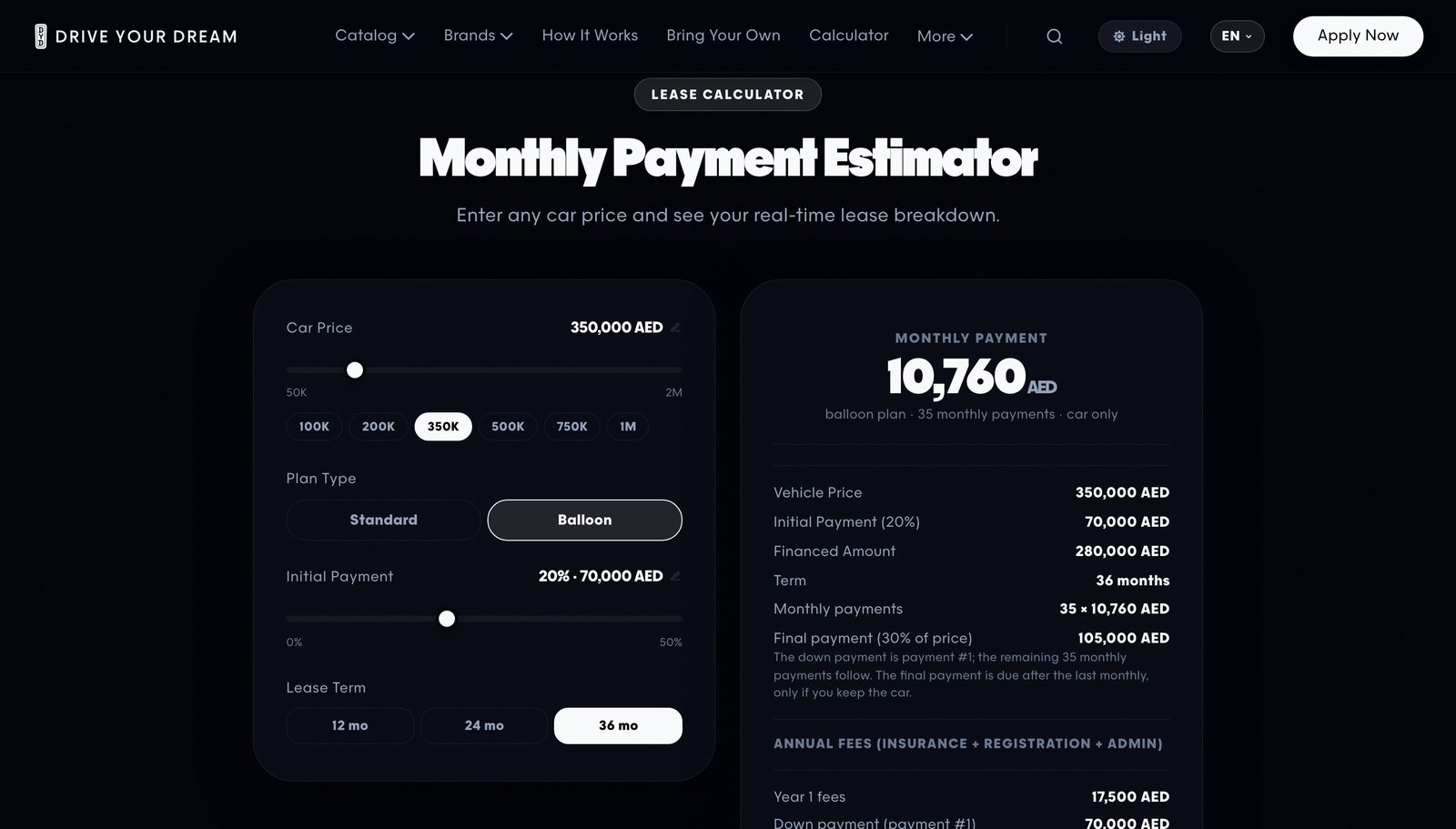
The commercial model has two payments, and the client publishes both. The monthly payment covers the car alone. Insurance, RTA registration and administration are a separate annual renewal — five per cent of the vehicle's value, minimum AED 8,000. There is an optional balloon at the end for a customer who keeps the car.
And one rule that a naive implementation gets wrong every time: the down payment is payment number one. Not an addition to the schedule — the first entry in it. A thirty-six month contract therefore has thirty-five monthly payments, and any implementation that divides by thirty-six quotes a number the company will not honour.
// The deposit is payment #1, so there is one fewer monthly payment.
const payments = down > 0 ? Math.max(1, N - 1) : N;
Why ordinary engineering discipline cannot see this class of error
The truth does not live in the code. It lives in a commercial offer sheet the sales team quotes from, and in a fleet that changes every week. A type system cannot check a figure against a spreadsheet. A linter cannot know that a car was sold on Tuesday. A conventional CI pipeline runs tests written by the same person who wrote the misunderstanding.
What was delivered
The engagement covered the commercial operation rather than a website, so the list below is what exists at the end of it. Every figure is counted from the codebase rather than estimated.
1. The commercial process. The lease model mapped end to end and restated in a form that could be implemented: the two payments and what each covers, the deposit as payment one, the term options, the balloon, what the sourcing programme accepts and what it refuses. This is the layer everything below inherits, and getting it wrong is the reason quoting tools disagree with the people using them.
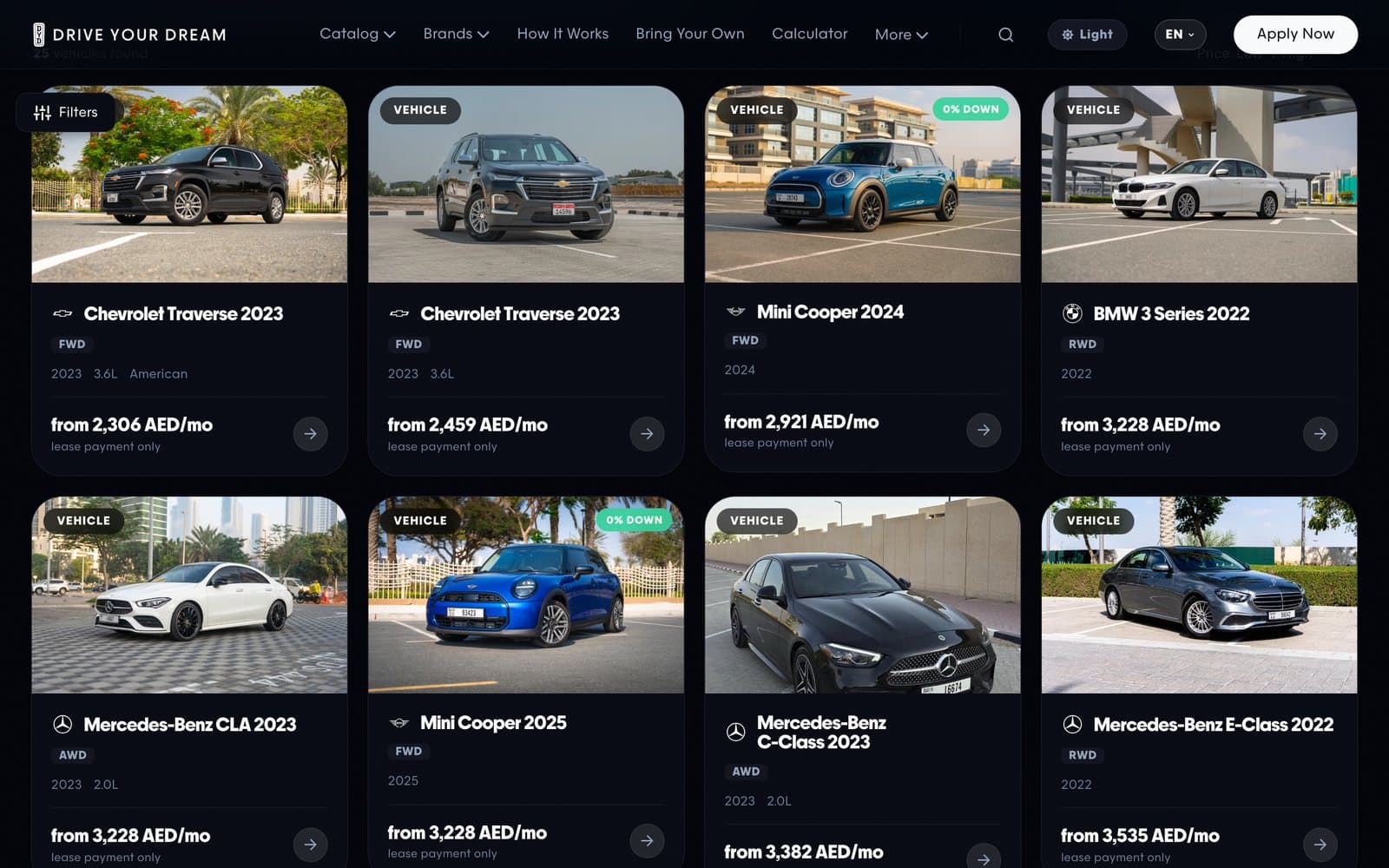
2. The platform. Ninety-nine pages, twenty-six API routes, five hundred and forty-nine prerendered addresses built from one fleet snapshot per deploy. Catalogue with a faceted filter that counts from the same projection it renders. Vehicle pages with an on-page calculator. Brand and model pages, including the ones with no stock, which sell the sourcing programme instead of apologising. A standalone calculator with keyboard entry on every control. English and Russian as two route trees with a single canonical language.
3. The connection to the fleet system. One integration point, running at build time, that pulls the fleet, projects it into three files, survives the upstream being down by keeping the last good snapshot and reporting its age, and reprices that snapshot with the current formula before publishing it. Plus the six-step pipeline around it, three steps of which exist only to stop a deploy.
4. The omnichannel CRM. Five entry points collapsed into one contact keyed on a normalised phone number: chat widget, WhatsApp, Instagram, the forms and calculator, and the phone. Fourteen API routes touching the platform, a webhook contract built for the vendor's failure modes rather than for the specification, and a thirty-six field schema in six groups that the agent and the salespeople share.
5. The AI agent. Method derived from the communication record of the salespeople who close, knowledge generated from the live fleet rather than uploaded, output written into structured fields rather than prose, voice specified in the brand book. It answers in the channel the customer arrived in and hands over what it was not built to handle.
6. Tools for the sales floor. A card generator producing share-ready images in three formats, personal signed access rather than a shared password, and a printed attribution code that survives being screenshotted and retyped. Fifteen admin screens over the fleet, brands, guides, page copy, leads and the search panels — the surfaces the client's team uses daily without calling anyone.
7. All of the writing. Seventeen long-form guides, the vehicle copy, the page copy in both languages, the reference material and the machine-readable files. Nothing on the property is generated: a person writes it and a person proofreads it.
8. The identity. The mark rebuilt and generated into four consumers from one source, three writing systems in seventeen subset faces, a token system carrying its own reasoning, twelve drawn body-type icons, a day and a night error page, the social-card renderer — and two books running to eighty-five pages that fix all of it and defer to the code.
9. The search and machine layer. Four sitemap files written at build time, structured data across the property as a linked graph, the machine-readable files regenerated from the fleet, a citable reference page with a published dataset, push indexing tied to the rebuild schedule, and search-console history that is now recorded rather than read and discarded.
10. Operations. Seven scheduled tasks, a nightly rebuild that makes stale data impossible, a publication queue that checks a page renders before announcing it, and error monitoring — because every assertion above runs at build time, and a check that never runs is worth nothing.
One function, twelve callers
Before the work, the lease calculation existed three times: in a shared library, in the runtime layer that renders vehicle pages, and in the build script that bakes prices into the catalogue. The copies had already diverged — two of them were hard-wired to a twenty-four month term with no balloon while the catalogue quoted thirty-six months with one. The price baked into the catalogue at build time and the price the on-page calculator drew were answering different questions on the same screen.
It is now one function of a hundred and twelve lines, imported by twelve files, and it deliberately has no imports of its own and no React. That constraint is the architecture: the same file is loaded by the Next bundler and by plain node inside build scripts, and a formula shared by two runtimes cannot be forked without the fork being obvious. The catalogue's own configuration is a named constant rather than four scattered literals, so “the catalogue price” has exactly one definition.
Three of the six build steps publish nothing
There are no runtime requests to the client's fleet system at all. Exactly one line in the codebase talks to it, and it runs at build time. Everything the visitor sees is a projection of a single snapshot taken once per deploy, which is why the catalogue, the sitemap, the structured data and the machine-readable files physically cannot disagree with one another: they are all derived from the same rows in the same build.
Six steps run before the site compiles. Three of them exist only to stop the deploy.
The build fails against the offer sheet. Nine vectors taken from the sales team's official offer sheet are run through the shared formula on every build, and any disagreement in the monthly payment, the number of payments, the drive-away total, the annual fee or the balloon exits non-zero. Nothing ships.
The build fails against the data. A second assertion recomputes every vehicle's monthly payment and throws if it differs from the stored snapshot by as little as one dirham. The module is imported by a page, so the exception takes the whole build with it.
The artefact refuses to exist. On the same disagreement, the card generator returns nothing and the endpoint answers 404 — so a salesperson gets no card at all rather than a card carrying a number the company will not honour. A card is a screenshot that outlives the data underneath it, and it cannot be recalled from a customer's phone. Refusing to draw it is the only safe refusal.
These are not unit tests. A unit test checks code with code, and would have passed happily on all three diverged copies of this formula. These assertions bind the code to a source of truth that lives outside it — a commercial document and a fleet that changes weekly. That is precisely the class of error no type system, no linter and no template CI pipeline can see.

When the client's system goes down
If the fleet system cannot be reached, the build neither fails nor publishes an empty catalogue. It keeps the last good snapshot, reads a separate timestamp file, prints the age of the data into the build log and raises a warning frame once that age passes a day. The unobvious half: it reprices the cached snapshot with today's formula before continuing, because monthly payments are materialised into JSON rather than computed at render time — so a formula change during an outage would otherwise ship prices that silently predate it, and the assertion above would then fail the build for the wrong reason.
The rule the section is built on: the system is permitted to be stale and required to say so.

The same discipline on facts that are not money
One rule decides what is for sale. A single predicate — not sold, has a price, confirmed available upstream — now drives the catalogue grid, the sitemap, the machine-readable files, the public API, the brand pages and the redirect check. It exists because four consumers had each handled the fleet system's contradictions differently and drifted apart. The upstream system is wrong in two opposite directions at once: it leaves cars marked available after they have left the fleet, and simultaneously returns data that makes every remaining car read as reserved. Roughly half of its records are not fit to show.
What we tell machines is regenerated, not maintained. A build step recomputes the fleet counts inside the machine-readable files from the live list, matching each counter by shape rather than by today's value — because those files had been edited by hand and claimed an order of magnitude more cars than the catalogue could show, with two different brand counts sitting a few lines apart in the same file. An assistant repeating that to a customer costs the client trust, and nobody notices, because nobody reads a seventy-kilobyte text file with their eyes.
And one line that inverts the marketing instinct.
/** Marketing-friendly fleet label: rounds down to nearest 10, e.g. "50+" */
export const fleetLabel = `${Math.floor(listableVehicles.length / 10) * 10}+`;
It rounds down, so the plus sign is always literally true.
The filter is a projection of the snapshot, not a query against it
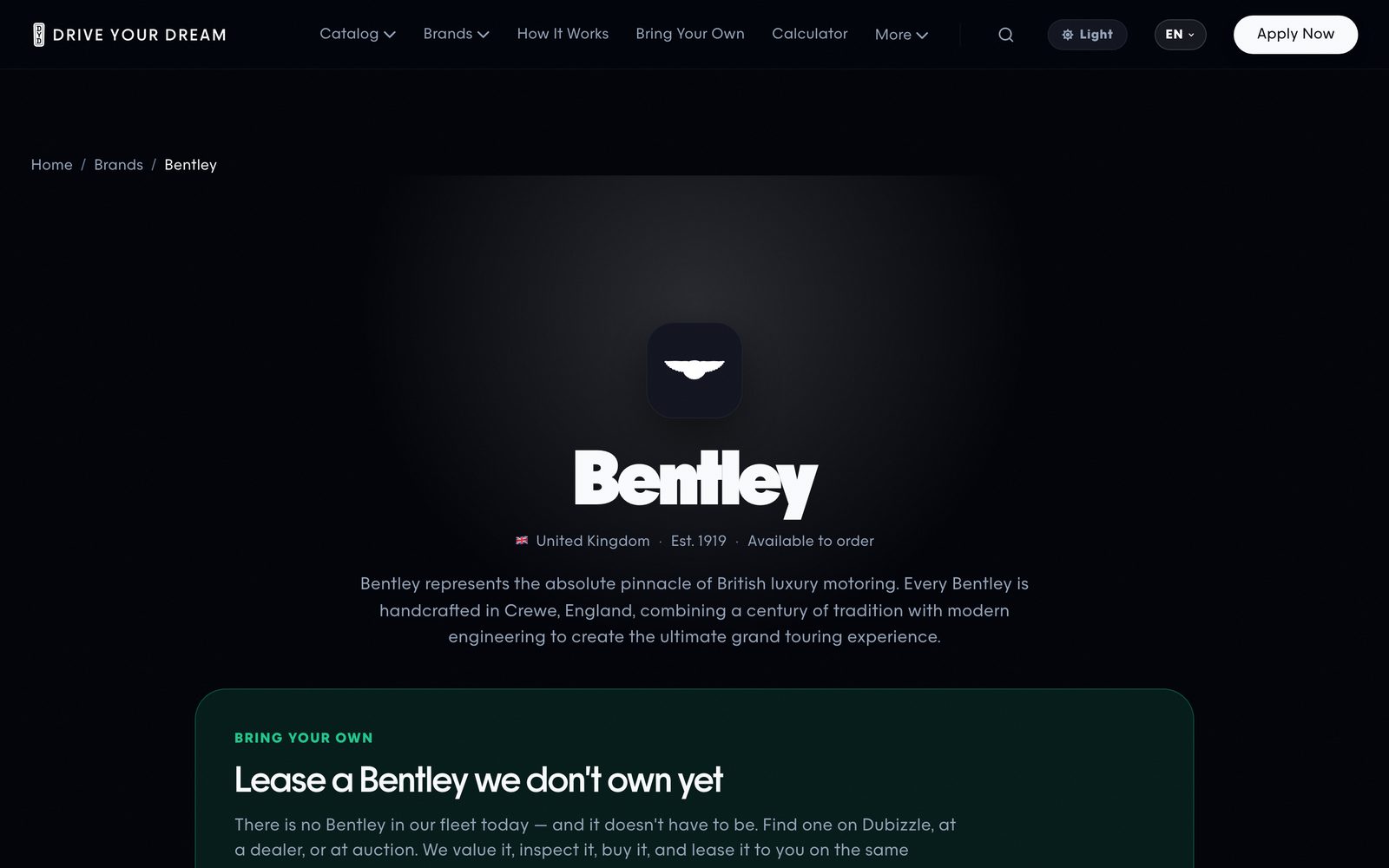
Every facet in the catalogue filter carries a live count — thirteen Mercedes, three Chevrolets, nine cars under five thousand a month — and those counts are computed from the same projection that renders the grid. The reason is not decoration. A filter that offers a band with nothing behind it is a dead end the visitor walks into, and on a fleet that turns over weekly a hand-maintained facet list produces those dead ends within days. Counting from the snapshot means the filter cannot offer what the catalogue cannot show.
The projection exists for a second reason. The full fleet record carries around fifty fields per car including registration details and every photograph from every shoot; a footer component present on every page was reading from it, so the bundler was shipping the entire fleet, plates included, into the browser on every route. The catalogue now reads a whitelisted projection — named fields, one cover image per car — and the whitelist is explicit rather than a blacklist, because a blacklist over a record somebody else will add a field to is a promise with an expiry date.
Five entry points, one contact, and an agent that qualifies before a human wakes up
The chat widget, WhatsApp, Instagram, the forms and quiz, the calculator and the phone all collapse into a single CRM contact keyed on a normalised phone number. A person who writes on Instagram, returns a week later to fill in the calculator and then telephones is one history rather than three leads competing for the same salesperson.
The agent's knowledge base is not a document somebody uploaded. It is generated from the same fleet snapshot the catalogue renders from, so when a customer asks what a particular car costs a month, the agent answers with the figure the site is showing and the salesperson will honour — not a figure from a PDF written in April. A car that left the fleet leaves the agent's knowledge in the same build that removes it from the catalogue. This is the point at which the whole apparatus above stops being an engineering preference: an agent grounded in a stale export will quote confidently and wrongly, at three in the morning, with nobody watching.
The agent was not written by whoever configured it. That is the ordinary failure of a sales agent: an engineer with a blank prompt imagines how selling works, and the result is a chatbot that asks the questions an engineer would ask, in the order an engineer finds logical, and states the price at the moment an engineer considers polite. It reads as competent and it converts badly, because nobody in the building ever sold that way.
We built this one from the company’s own record instead. The communication history of the salespeople who actually close was read for its structure: which questions come first, what is established before a number is named, which objections get a direct answer and which are deferred to a human, and the point at which a conversation stops being qualification and becomes a booking. That sequence — not a prompt written from imagination — is what the agent runs. It inherits a method that was already working in the room rather than inventing one.
Three consequences worth stating, because they are what makes it hold up in production.
The knowledge is live, the behaviour is fixed. Those are deliberately separate. How the agent conducts a conversation changes only when somebody decides it should; what it knows changes on every build. Collapsing the two — a single document carrying both the manner and the facts — is why so many agents drift: an edit meant to correct a price quietly rewrites the way the thing talks.
It writes into fields, not into prose. What the agent establishes lands in the structured schema, so a salesperson opening the contact reads a state they can disagree with in one glance. An agent that produces only a transcript leaves a human to re-read the whole conversation, which is the same work done twice and the reason most “automated qualification” saves nobody any time.
Its voice is specified where the rest of the brand is. The brand book carries a chapter on how the agent speaks, alongside the chapters on the mark and the typography — because to a customer at midnight the agent is not a feature of the brand, it is the brand, and leaving its register to whoever last edited a prompt is the same as leaving the logo to whoever last opened the file.
And the limit, stated by us: an agent derived from a body of past conversations is bounded by what those conversations covered. It handles the questions this market actually asks because those are the questions in the record; something genuinely novel reaches a human, which is the correct outcome and is designed for rather than discovered.
Around that sits a configured agent with a knowledge base built over the actual commercial model — the two payments, the term options, the deposit rule, what the annual fee covers, what the programme refuses to source. It answers in the channel the person arrived in, at the moment they arrive, and it writes what it learns into a structured field schema rather than into free text: thirty-six custom fields in six groups covering the current lease, the intended purchase, qualification, tracking, scoring and the agent’s own state. We are deliberately not listing the fields here; the shape is the engineering, and the contents are the client’s.
Two figures the client’s CRM reports for this layer: a median first response of sixteen seconds, and over ninety per cent of enquiries qualified without a human touching them. Both are platform metrics from the CRM rather than anything we instrumented ourselves, and they measure the channel — not revenue, not conversion, and not the site.
Bring Your Own: the absent car is the product
The site's strongest search positions were for cars the company did not own. A brand page for a marque with nothing in stock ranked in the top ten, the visitor arrived, read “0 vehicles available” alongside some encyclopaedia text about the factory, and left. That was the cheapest traffic the business had and it was being discarded on arrival.
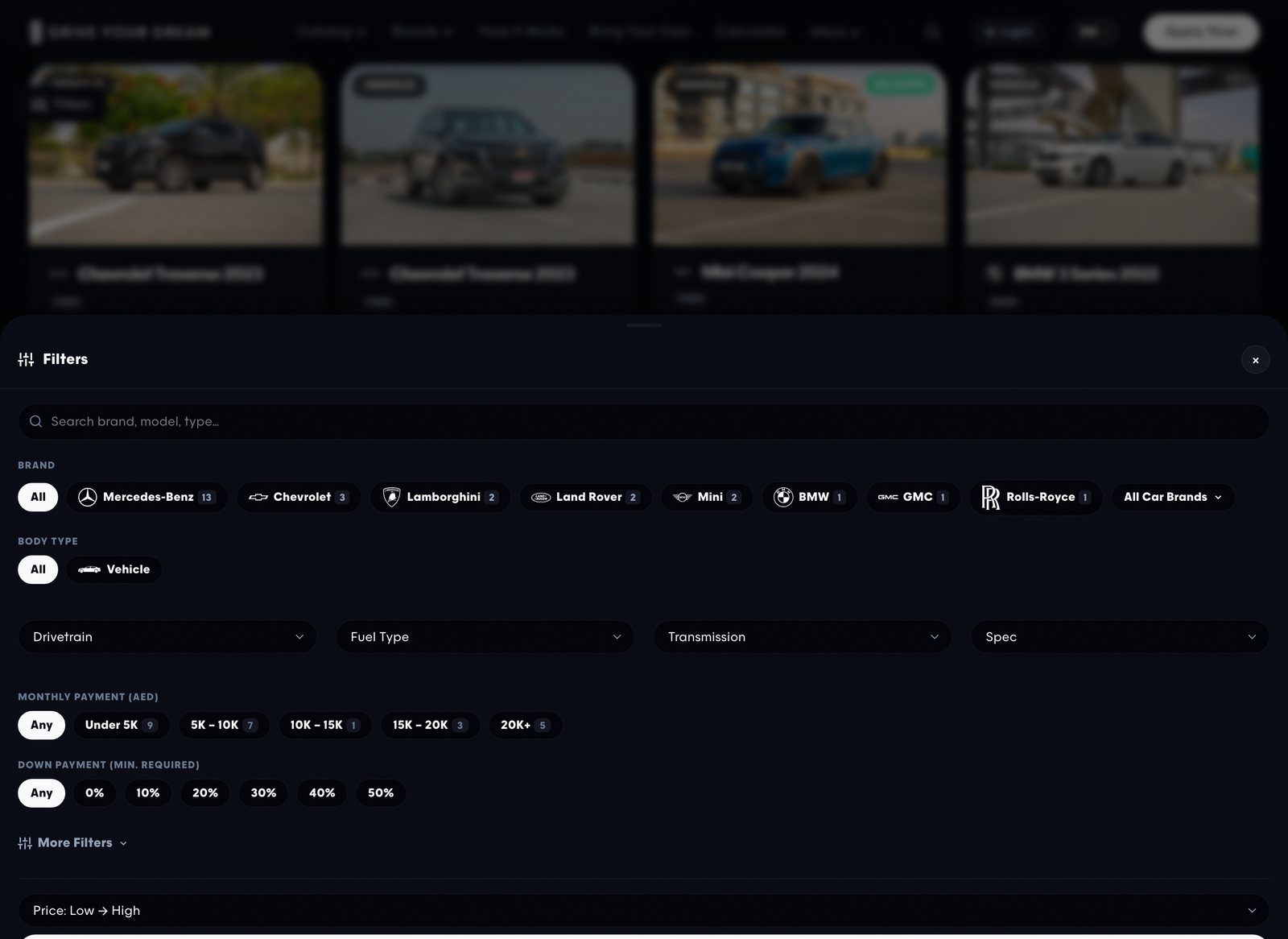
The reframe is the whole point, and it is commercial rather than technical: a car missing from the fleet is not a hole in the catalogue — it is precisely what the sourcing programme exists for. The fleet is bounded at a couple of dozen cars. The programme is not: it will take any car on the UAE market. So a brand page with no stock stops describing an absence and starts describing a service.
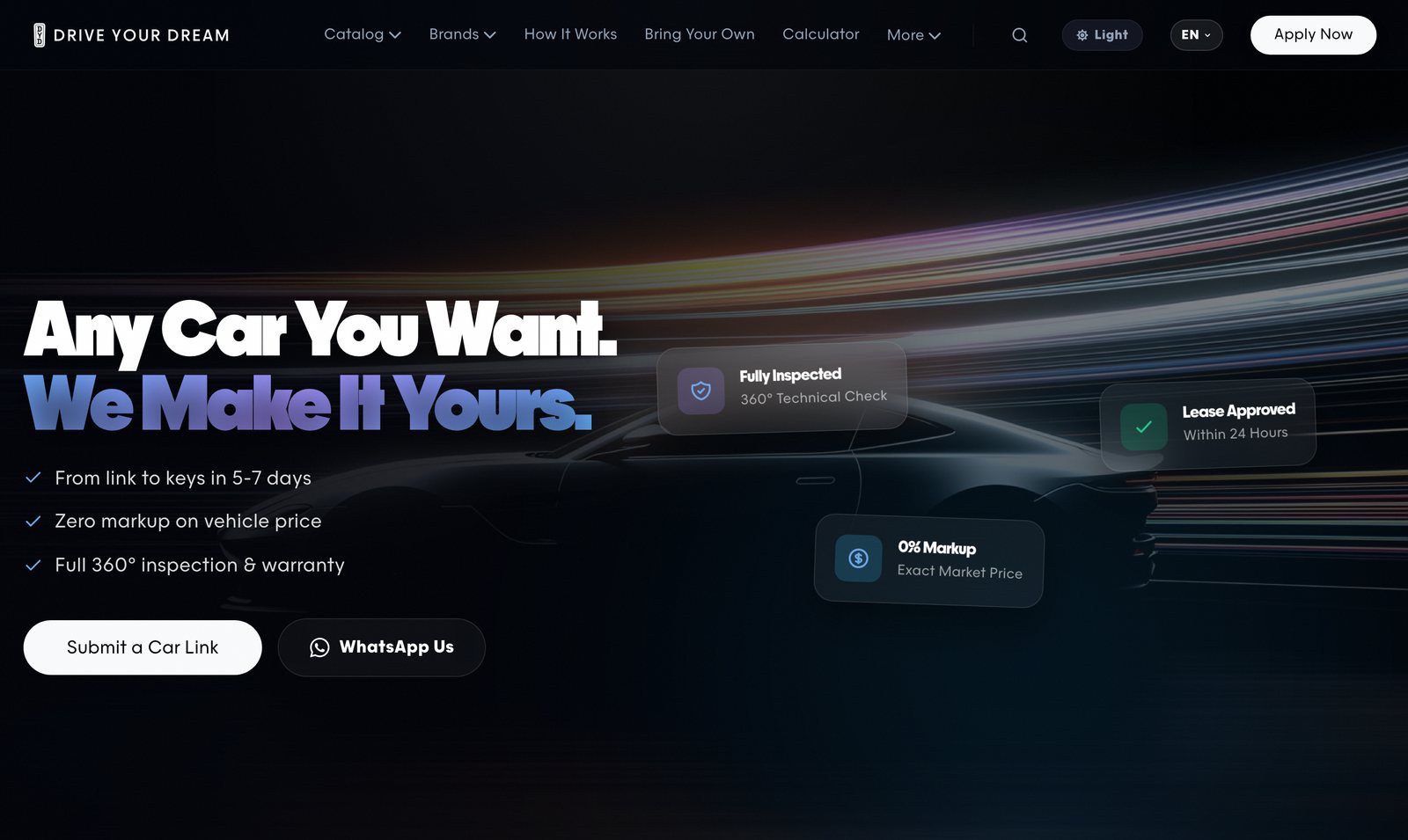
The mechanic runs in five steps, and the page states a duration for each rather than promising speed in the abstract. The customer finds a car anywhere in the market — a classifieds listing, a dealer, an auction — and sends three or four links. A market valuation runs against the lowest listed comparables, days on market and the vehicle's own history, so the buyer does not overpay for their own choice. A hundred and fifty point inspection follows, and the report goes to the customer rather than staying with the company. Only then does the company buy and register the car, and the lease starts on the same terms as anything in its own fleet. Five to seven working days from a link to keys, and no mark-up on the vehicle price.
And the page states what the programme will not take, next to the steps rather than in a footnote: salvage or heavily damaged cars, anything that fails the inspection, unclear ownership or outstanding fines, and cars outside the UAE. A refusal answers “what is the catch” better than another paragraph of adjectives, and it is the part a customer remembers.
How the programme reaches the agent before a human does
This is where the sourcing programme meets the channel layer, and the join is one deliberate detail. Every WhatsApp entry point on the site builds its link with the source and the page embedded in the pre-filled message text — not in a query parameter, not in a cookie. The reason is mechanical: the CRM reads the first message body, so anything placed there is visible to the agent and to the workflows immediately, before a person has opened the conversation.
So a customer who lands on a brand page with no stock, reads the programme and taps through arrives in the inbox already carrying which marque they came for and which page they were on. The agent runs the same qualification sequence it runs for a car in the catalogue — what the deposit looks like, which term, what the person actually needs — except the vehicle does not exist yet. It collects the links, establishes the shape of the request and writes it into the same structured fields, so a salesperson picking it up sees a sourcing brief rather than a transcript to re-read.
The consequence is that the cheapest traffic on the site — a search for a car the company has never owned — now reaches a qualified request without a person being awake for it. That is the whole argument of this record applied to demand rather than to arithmetic: the interesting engineering is in what the system refuses to waste.
Search: the sitemap is a build artefact that refuses to advertise thin pages
Four XML files are written into the public directory during the same prebuild that pulls the fleet. The obvious approach in this framework is a dynamic route; it produced caching conflicts and fetch errors in Search Console, where Google periodically could not retrieve the file at all. A static file on a CDN cannot have that problem.
More interesting is what the sitemap declines to include. Model pages are listed only where two or more cars are available; brand pages only where there is stock; archived cars never. The pages stay live and reachable — what is withdrawn is the invitation. A model page with one car behind it is a template wrapped around a link to a page carrying an order of magnitude more text; it cannot win a second result, it splits the signals, and it spends crawl budget. Every exclusion is logged into the build output rather than happening quietly.
And an hreflang implementation that refuses to lie. Where a Russian route serves English text, the alternate is suppressed entirely and the page canonicalises to the English original instead of to itself — because declaring a Russian alternative on a page whose canonical points elsewhere sends two contradicting signals in one breath. Thirty-five entries in the sitemap deliberately carry no Russian alternate. That is the opposite of what almost every internationalisation boilerplate does by default.
Machines: what the site tells them is regenerated, and one refusal is deliberate
The same facts are published three times — as crawlable prose, as structured data, and as flat text files — and most of the engineering goes into making those three copies unable to diverge. The build recomputes the fleet counts inside the machine-readable files and rewrites every occurrence, matching each counter by its shape rather than by today’s value, so a stale number from any past edit is repaired rather than only the current one.
The reference page is the citable artefact: median payment across the live fleet, the range, a sensitivity grid, a dataset declaration pointing at a CSV, and a ready-made citation line with the date the figures were computed. The CSV is served inline rather than as a download, so a crawler following the dataset link receives the rows, and it carries no byte-order mark, because a strict parser reads one as part of the first column name and silently breaks the correspondence with the declared variables.
The entity graph links the organisation, the dealer record with its coordinates, the site and the service nodes by identifier rather than by repeating the organisation inside each one. And it contains one deliberate absence: a pair of self-issued rating and review objects was removed, because self-serving reviews on a dealer entity breach the structured-data policy — that is an exposure to a manual action rather than stars in a results page. The genuine reviews live in the client’s public business profile and are linked from the graph instead. Declining a rich result is the kind of decision that is only ever visible in a code comment.

The identity, and a brand book that defers to the code
The brand is ours too — the mark, the typography, the palette, the tone of voice and the twenty-two chapter book that fixes all of it. The book opens with a rule that is unusual enough to be worth quoting, because it is the same discipline as everything else on this page pointed at ourselves:
The book records decisions. The values live in the code and are commented there. If a figure in the book disagrees with the code, the code is right and the book must be corrected.

It runs to two documents and eighty-five pages — forty-one on identity, voice and application, forty-four on typography and visual style for anyone producing material. Neither was set by hand: both are rendered from the same source that states the rules, so correcting a value corrects the book.
A brand book is normally the most authoritative document in a project and the first to go stale, because it is a PDF and the product is not. Subordinating it to the source removes the question of which one to trust. One of its chapters specifies how the AI agent speaks — the identity covers the machine as well as the marketing, because to a customer at midnight the agent is the brand.
Three writing systems, switched in CSS rather than in JavaScript. Latin, Cyrillic and Arabic, each in a display and a text cut. The switch is a custom property redefined on the language selector, so no component knows which family it is set in and no script chooses a font. This is a constraint rather than a preference: the Latin family contains no Cyrillic glyphs at all, so the Russian routes would otherwise fall back to a system font mid-page.
Seventeen faces, shipped twice, and never more than one family per visitor. Each face is built as a woff2 for the browser and as a TTF for the image renderer, which cannot read woff2 — and the pipeline rewrites the weight class and the name table on the way out, because a previous set carried the word “Light” in the names of all three files and rendered correctly only for as long as nothing trusted its own metadata. The subsets are per script, so a visitor loads the alphabet they are reading and no other.
The logo is generated, not maintained. One script sets the wordmark and converts the glyphs to outlines, writing identical path data into four consumers — two SVG files, an inline copy for the social-card renderer and a React component. The text becomes curves rather than staying text because the mark travels into share images, favicons and other people's hands, where a font either fails to load or is silently substituted. Two hand-maintained copies of a logo diverge quietly, and the divergence surfaces in stories already published, where it cannot be fixed.
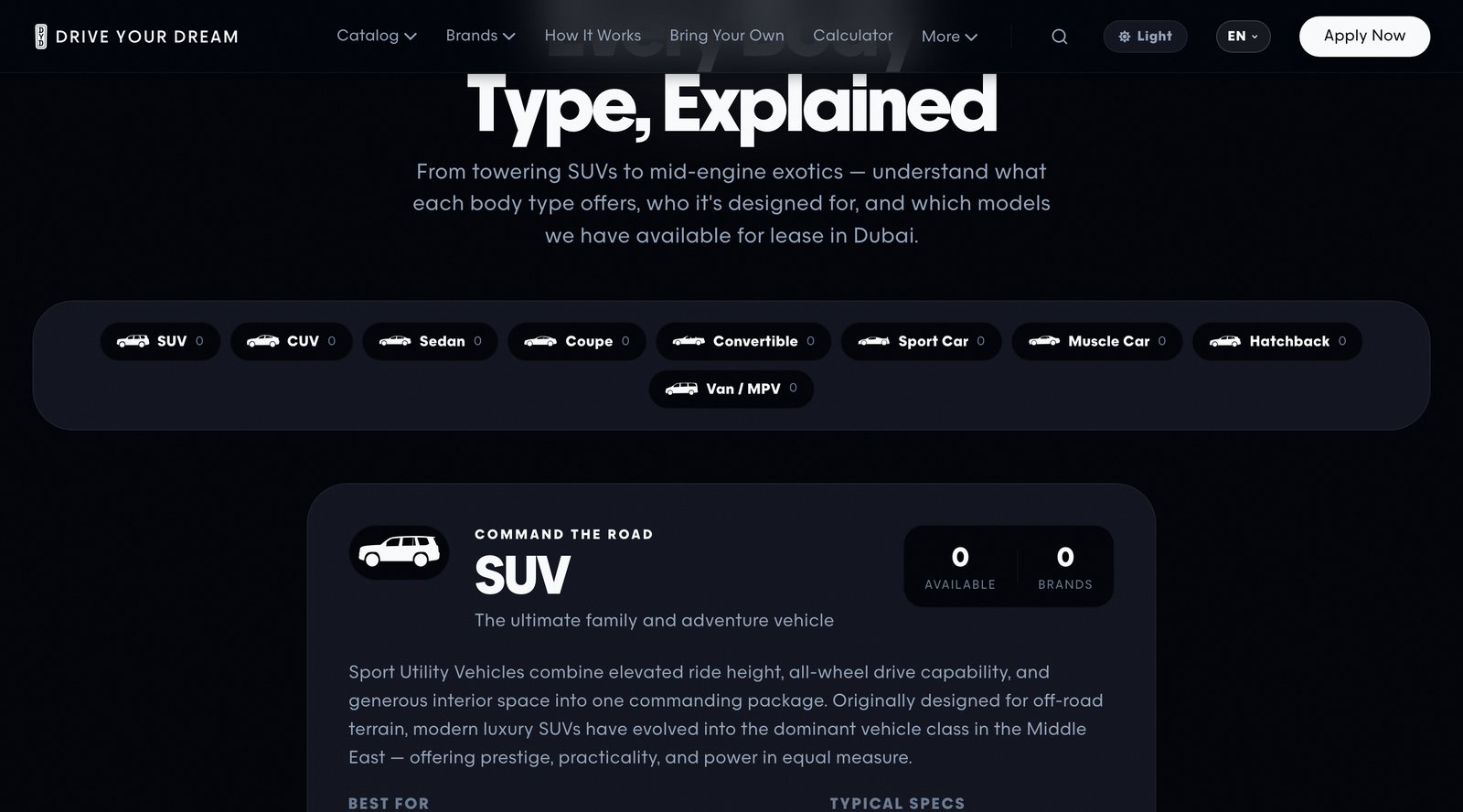
The palette and scale live in one token file that carries its own reasoning next to the values, including the bugs that produced them: two variables once referred to declarations that never existed, and var() without a fallback yields an invalid value, so twenty-two divider rules simply drew nothing. The weight scale skips 600 deliberately, because the family has no 600 — browsers resolve it silently to 700, so two adjacent elements set to 600 and 700 render identically, the hierarchy disappears and nothing anywhere reports an error.

Guides, and the graph they are written into
Seventeen long-form guides sit alongside the catalogue — what a lease actually restricts, what GCC specification means against an import, what the summer heat does to a battery and a tyre, why a supercar is leased rather than bought. They are not filler around keywords: each answers a question a buyer in this market genuinely asks before committing to a three-year contract, and each links into the catalogue at the point where the answer becomes a decision.
The structure is the point. A link audit found sixty-seven pages with no internal route into them at all — live, indexed, and reachable only from the sitemap, which is the same as unreachable for a reader. Building the graph took the count to zero, and the footer, the model index and the guide cross-links now exist so that every page sits inside the argument rather than beside it.
Publication runs through the same discipline as everything else. Articles are written as files, validated by a command-line check and parked unpublished with a date. A scheduled task flips the flag, triggers the rebuild, then fetches each new URL and only announces the ones that answered — because announcing a URL before it has rendered sends a crawler to a 404, and on incremental rendering a page materialises on first request, so the reachability check doubles as the warm-up. Nothing generates the text: a person writes and proofreads, and the scheduled task changes a boolean.

The channel layer, where the contract belongs to somebody else
Five entry points — the chat widget, WhatsApp, the forms and quiz, the calculator and the phone — collapse into one CRM contact by normalised phone number. The engineering here is mostly defensive, because the vendor writes the contract and changes it without telling anyone.
Answer 200 even when you mean 401. The inbound webhook parses the body, checks a shared secret and returns 200 immediately, doing the work afterwards. Malformed JSON: also 200. The reason is that the platform disables a webhook after roughly thirty failures in thirty minutes, so the textbook-correct status code is precisely the one that takes the integration offline — and a silent 200 also declines to tell a stranger's scanner that their guess was wrong.
An identity bug fixed by call order rather than by code. The custom channel names a new contact after whatever identifier it was handed, which is the phone number, so an agent opened a card headed by a number instead of a name. Enrichment originally ran before the message was sent, and the channel then overwrote the name that had just been set. The fix was to swap the order.
Two silent failures in the vendor's API. Custom fields are only accepted in snake_case — a camelCase key returns 200 and stores nothing. A freshly created contact is not immediately searchable, so looking its id back up returns null. Both failures look like success: the CRM appears connected and the salesperson's briefing is quietly empty.
And the smallest artefact carries the same thinking. The attribution code printed on a shared card — DYD-4H7K-DDI9 — uses a Crockford base32 alphabet with I, L, O and U removed, because the code is read off a phone screen and retyped by a human, and 0/O and 1/I are the mistakes humans make. The vehicle is encoded from its stable identifier in the fleet system rather than from its URL slug, because slugs drift when the upstream record is corrected.
Correctness needs an alarm
Every check above runs at build time, and a check that never runs is worth nothing. Fleet data is baked at build; there was a period when nobody rebuilt and the published data simply stopped matching reality. A scheduled task at 01:00 UTC now triggers a full rebuild through the whole six-step pipeline, and search engines are pinged ninety minutes later, deliberately, so that the URLs being announced already exist.
What can be checked
On 4 September 2026, in a fresh session with no history, Gemini was asked “Rent to own g63 in Dubai, no credit check”. It cited Drive Your Dream in the opening paragraph and listed it first among the providers it named. One observation is not a measurement — answers vary between runs — but it is the behaviour the machine-readable layer was built to earn. Twelve days later we ran the measurement properly, and it is set out below.
The artefacts are open. The reference page states the median lease-to-own payment across the live fleet, the cheapest and most expensive cars, and the annual fee at the median price — all computed from the same snapshot and the same function as the public calculator, and all dated. The CSV behind it is served as text rather than as a download, so a crawler following the dataset link gets the rows. Anyone can open both and check that the site agrees with itself.
Measured: forty buyer questions, two assistants, three languages
On 16 September 2026 we put forty buyer-intent questions to two assistants — thirty to ChatGPT, ten to Perplexity — in English, Arabic and Russian. Each was asked in a clean session so that no answer was shaped by the history of the one before it. We recorded whether the company was named, where in the answer it appeared, and whether the terms were reproduced correctly.
Nothing below was bought. No links were purchased for the domain, no external placements were commissioned for link equity, and no paid search was run: the advertising accounts show zero spend for the entire period. Nor could placement have been bought in most of these answers — ChatGPT carries no advertising positions at all. The only available lever is how clearly and honestly the site describes itself to a machine.
Perplexity answered one question with the company rather than with a list. Asked “which Dubai company approves a car lease in 24 hours without a bank?”, the answer opens: “The Dubai company that explicitly advertises car-lease approval in 24 hours without involving a bank is Drive Your Dream.” What follows is a breakdown of the terms, sourced to the site. In five further scenarios the company is named first or cited as the source of the answer: leasing without bank approval or a credit check, the freelancer with no salary certificate, the documents required, new residents with no UAE credit history, and zero down payment.
The price came back exact. Asked what a Mercedes G-Class costs, Perplexity answered “from approximately AED 16,909 per month” and cited us, while quoting 30,000–40,000 from other companies’ rental listings alongside. Ours is precise because it is published as a machine-readable range on every model page: for the G-Class, nine cars between AED 16,909 and AED 25,055. The assistant did not estimate. It read the number.
In Arabic, the company appears above the answer. Asked in Arabic for lease-to-own in Dubai without a bank and without a credit check, ChatGPT surfaced Drive Your Dream as a card above the body of the reply, rated 5.0 and marked open. That is the most prominent position an assistant answer has: the reader sees the company before they begin reading the text.
The terms survive the retelling, which is the technical result that matters. The assistant does not paraphrase marketing copy; it reproduces contract terms: “No bank approval and no AECB credit check — 12–36 months; Emirates ID + UAE licence; annual insurance/registration/admin fee applies.” Term length, the absence of an Etihad Credit Bureau check, the document list and the structure of the annual fee all came back correct, because the site publishes them where a machine can read them rather than leaving them to be inferred from prose.
One pattern runs through all of it. The company is found when a person describes their own situation, not when they compare brands. “The bank turned me down”, “I have no salary certificate”, “no credit check”, “approval within a day” — on every one of those phrasings the company is in the answer. For vehicle leasing that is the half of the audience worth having: somebody asking which company is best is still choosing, while somebody asking what to do after a bank refusal is ready to sign. The site was built for the second question on purpose.
Two honest limits. This is one snapshot on one date, and assistant answers differ between runs; a serious reading requires the series, not the single pass. And it measures visibility, not revenue — being named is not a sale, and nothing here is offered as a traffic or conversion figure.
What this does not prove
Four things, stated by us rather than left for a reader to find.
The defences are preventive. Each was written after a specific defect reached production, which means there is no counter of deploys stopped. Honest: the deploy now fails on a discrepancy. Dishonest: this caught N bugs.
Almost every figure on this page is a byte, a route or a constant. The two exceptions are the channel metrics — the sixteen-second median response and the share of enquiries qualified without a human — which the CRM reports and we did not instrument. There is no Lighthouse run, no field performance data and no conversion or revenue figure attached to this work, and we are not going to imply one.
The pipeline guarantees internal consistency, not truth. When the upstream system is wrong, the site is faithfully wrong along with it — and reports the age of its data.
One area is deliberately outside this discipline. The cost-of-ownership model behind the cash / loan / lease comparison is an estimate with no external source of truth and no assertion guarding it. The lease side of that comparison always comes from the shared formula; the rest is modelled.
What we are actually selling
For any business whose website states numbers a human then has to honour — prices, availability, eligibility, capacity, stock — the interesting engineering is not the framework. It is the question of what the build refuses to publish.
- 3 of 6
- build steps whose only job is to stop the deploy
- 9
- offer-sheet vectors re-checked on every build
- 12
- callers of the one lease calculation, down from three copies
These are engineering facts measured from the codebase on 3 September 2026, not business outcomes. The assistant-visibility measurement of 16 September 2026 is a separate exercise and is reported as such: it records where the company appears in answers, not traffic, conversion or revenue, none of which was instrumented.
Each has a definition, a denominator and a documented way of being got wrong. The definitions are on this site, and they are the same ones we hold ourselves to here.
- GEO
- Forty buyer-intent questions put to two assistants in English, Arabic and Russian — thirty to ChatGPT, ten to Perplexity — each in a clean session. Nothing was bought: the advertising accounts show zero spend for the period, and ChatGPT carries no advertising positions at all.
- Citation
- Asked which Dubai company approves a car lease in 24 hours without a bank, Perplexity opened with the company by name and sourced the terms to the site. In five further scenarios it was named first or cited as the source of the answer.
- Structured data
- A price published as a machine-readable range on every model page came back exact: from AED 16,909 a month for the G-Class — nine cars between 16,909 and 25,055 — beside 30,000–40,000 quoted from other companies’ listings. The assistant did not estimate; it read the number.
- Entity
- Asked in Arabic for lease-to-own without a bank and without a credit check, ChatGPT surfaced the company as a card above the body of its reply, rated 5.0 and marked open — the most prominent position an assistant answer has.
- Retrieval
- The company is found when a person describes their own situation — the bank refused me, no salary certificate, no credit check, approval within a day — and not when they compare brands. Contract terms came back verbatim: 12–36 months, Emirates ID plus UAE licence, no AECB check.
- Domain invariant
- Three of six build steps exist only to stop the deploy, and nine offer-sheet vectors are recomputed on every build against fixed expectations. Twelve callers share one lease calculation, down from three copies of it.
- Internal link graph
- A link audit found sixty-seven pages with no internal route into them at all — live, indexed and reachable only from the sitemap. Building the graph took the count to zero.
Each names what it is good for and the point at which it stops working. This record is the evidence those pages cite, which is why the link runs in both directions.
- Respond.io
- An omnichannel inbox that puts WhatsApp, Telegram, Instagram, web chat and email behind one conversation record.
- WhatsApp Business API
- Meta's official programmatic channel for businesses on WhatsApp, rated by how many conversations a number may start per day.
- Retrieval-augmented generation
- Answering from a body of documents the model retrieves at question time, rather than from what it absorbed in training.
- Next.js
- A React framework that decides, per route, whether a page is rendered once at build time or computed on every request.
- React 19
- React is a JavaScript library that describes an interface as a tree of functions of state, and recomputes the parts of that tree whose state changed.
- Supabase
- Managed PostgreSQL with an authentication service, file storage and a generated HTTP API in front of it, addressable directly from a browser.
- Vercel
- A hosting platform built by the authors of Next.js, where a push to a git branch becomes a globally cached deployment whose per-route cache behaviour is taken from the framework's own build output.
- Python
- A general-purpose language whose value in this practice is narrow and specific: the reference implementations for reading and writing awkward archive and binary formats — .docx, .xlsx internals, font tables — are written in it.
- Playwright
- A Node library that launches and drives Chromium, Firefox and WebKit through one API — written for end-to-end tests, equally usable as a scriptable browser.
- JavaScript
- The language of the browser, run on the server too — used here without a type layer on top of it.
What made this record possible was a diagnosis before a proposal. That is the same first step whatever the system is, and it is the one thing worth asking for now.